The Financial Wholesaler Podcast Episode 6: Maximizing Your Brand Through Personal Storytelling
In Episode 6, Mitch Santala is joined by Kirk Wayman to explore why personal brand, not product, has become the true differentiator in financial wholesaling. As products and performance continue to converge, the conversation shifts to identity, value creation, and how the way you show up in the room ultimately determines whether you are trusted, remembered, and invited back. Through real-world stories, metaphors, and deep reflection, Kirk unpacks how wholesalers and advisors can move beyond generic messaging and build a brand rooted in who they truly are.
You’ll discover:
How to get called back more often
How your identity work reveals your unique value
How story, language, and self-awareness turn safe conversations into meaningful ones
Whether you are early in your career or rethinking how you show up today, this episode offers a powerful framework for understanding your value, communicating it clearly, and building trust through conversations that actually matter. Watch now!
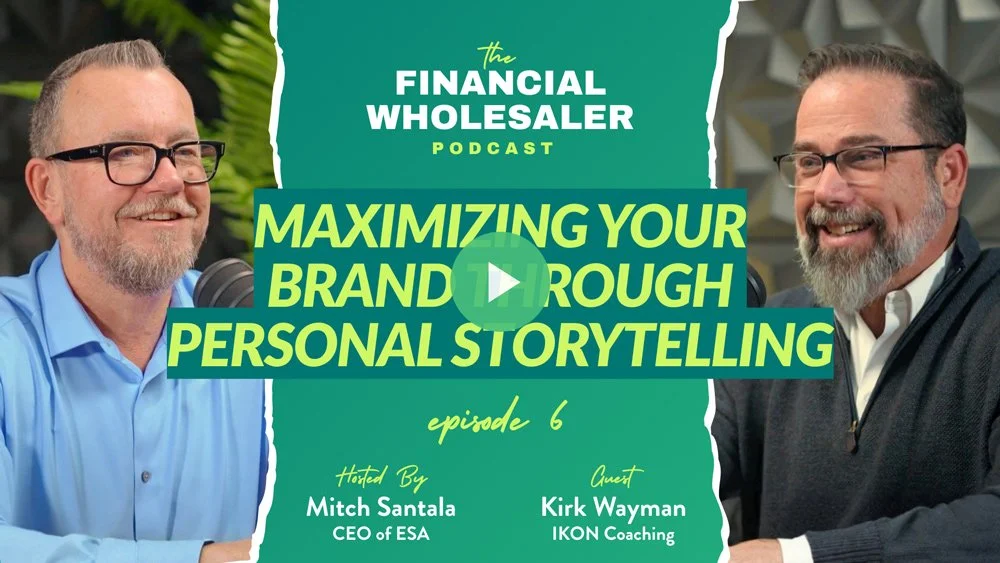
Episode Timestamps: Maximizing Your Brand Through Personal Storytelling
0:00 – Introduction: Mitch opens the episode and frames why personal brand matters more than product in today’s wholesaling landscape.
02:00 – A real-world example of an advisor who stalled until he leaned into his natural strengths and voice.
05:30 – Why personal branding is now essential for financial wholesalers, not optional.
09:15 – Product branding versus personal branding and how relying only on products limits growth.
10:40 – Why identity comes before brand and why surface-level branding exercises fall short.
12:20 – The problem with generic brand language and values everyone claims to have.
13:05 – Why standing out requires subtraction, focus, and being willing to exclude.
15:30 – The career shift from taking every client to specializing and letting poor fits go.
17:40 – The fish and water analogy and why your greatest value is often invisible to you.
19:00 – The three steps of value creation: seeing it, valuing it, and learning how to deliver it.
20:50 – Where real self-discovery begins and why past mistakes reveal more than strengths lists.
22:50 – When strengths become weaknesses through overuse or poor timing.
24:30 – Why self-discovery is a community activity and how others reveal your blind spots.
26:20 – Turning identity into language others can understand and respond to.
27:15 – The hammer, the bear, and the dark forest: using story to communicate how you create value.
32:15 – Why safe conversations stall growth and meaningful conversations create trust.
35:00 – Final takeaway: your product gets you in the door, but your personal brand gets you called back.
-
The Financial Wholesaler Podcast
Episode 6: Maximizing Your Brand Through Personal StorytellingKirk:
The mutual funds, the annuities, the yields. All that stuff is kind of the same. I think there's a given that most products meet a minimum standard. That brings them all to a level of performance that we should. There's a quality and excellence in those that we expect. Yeah. So therefore when you're working with an advisor, all of those pieces have to be good and excellent and in place.But what's the differentiation. And it's you. Yeah. And your voice and how you show them.
Mitch:
Today we get another flavor of wholesaler branding. Every wholesaler has their own brand. Some know it, most don't. But the advisor in the room fills it instantly. Your brand, named or not, is already shaping the meeting. Today we get Kirkman's intrinsic take on personal branding. While your story, your strengths, and the way you see people is the real differentiator.Because in a world where products look the same. The meeting becomes your brand platform and the brand is you, the truest version of yourself. Welcome to the Financial Wholesaler podcast. Conversations about meetings that matter.
First of all, just introducing you, Kurt. You're my friend. You are a vocational coach working with executives, financial wholesalers, CEOs.
So you have a unique angle of how we're going to speak to branding and storytelling. We're going to get into that. But give us first just an example of where you saw the shift between maybe a financial wholesaler or a financial professional where they elevated their brand beyond product branding to what we would say, personal branding.
And those two together launched them into a whole new dimension.
Kirk:
Yeah. So a number of years ago, I worked with a financial advisor in this case, and he was doing great work. I mean, it was fine. It just wasn't going anywhere. It was just sort of going along, you might say. And we sat down, we started working through this, and we really just started to discover who he is and what he's uniquely skilled at and how his voice works, you might say.And along the way, he discovered that he has this capacity, which not everybody has to ask these really penetrating, courageous questions. Now, of course, that can get you in trouble in a lot of situations. But inside of a money conversation, when those are framed well, it really unlocks a whole bunch of things the client needs to be thinking about.
Sure. And as he did that, he started to recognize he'd have couples sitting in front of him facing retirement, or maybe a widow sit in front of him, or just the kind of client that he was working with. And he began to realize that it was the women, the wives, who were really finding value and resonating with what he was doing.
A lot of times, an overbearing husband that may have been in charge of the money for their whole marriage would kind of dominate the conversation. And he could shape it in a particular way where the wife would come alive in this new way. He didn't really know he was even doing it.
But as we started to look at what was going on, we realized he had the ability to take care of a conversation about money in a way that dropped it past the money conversation. These wives were coming alive. They were leaning into the closing. They were saying things to their husband like, hey, we're working with this guy. This guy gets us. Which meant this guy gets me.
When we looked across his book of business, he realized it was loaded with this type of woman. Divorced, widowed, married. He built his brand around this avatar. That accelerated his close rates and his ability to create incredible value. And the coolest part was that he started closing larger and larger clients.
Mitch:
Which we all like to hear.Kirk:
It's a good outcome.Mitch:
It's a good outcome. Yeah. So to the financial wholesaler we're speaking to today, why is developing personal branding so important in the world of financial wholesaling?Kirk:
Yeah, I would say it's incredibly important. And the reason is we have to look back over the human experience. We've had three major eras of economic activity.First was agriculture, where the central problem was hunger. The land was the means of production. Then we moved into the industrial age, where capital, factories, and machines became the means of production. People were treated like parts of machines.
Over time, we began to understand humans are not machines. Human resource departments emerged. Eventually, we reached a point where owning the machines was no longer enough.
When Microsoft replaced General Motors as the most valuable company, the means of production started clocking out and going home. Human creativity, insight, and identity became central to value creation.
Now, who you are is how value is created. The product still matters, but the person delivering it matters more.
In sales, that uniformity broke down. People no longer wear the same suit. Differentiation matters. In financial wholesaling, products still matter. Companies still matter. But there is less differentiation there than ever before.
Mitch:
They do bring the product.Kirk:
They do. But increasingly, the differentiation is you. Your voice. How you show up.Mitch:
Whether you're a financial wholesaler or advisor, you can brand yourself to your product or add a personal dimension. You approach this differently. Walk us through your process.Kirk:
That surface approach has value, but it's entry-level work. The real differentiator is identity. Your brand must reflect your identity.We walk people deep into their story. Successes. Failures. Pain. Mistakes. Inside those mistakes are tools. Often misused.
That work fuels a real brand. Otherwise, you end up with generic language. Open. Curious. Vulnerable. Those are virtues. Being a good human. But not distinctive.
Mitch:
Exactly. Those often come from external voices like company values. Real authenticity comes from going deeper and integrating who you really are.Kirk:
Marketing works the same way. Poor marketing casts too wide a net. When you say everyone, you say nothing. Identity work is about distinctiveness. It is about subtraction.That leads to understanding your value creation mechanism. How you are uniquely wired to create value. That is what allows you to stand out.
Mitch:
And that risks rejection.Kirk:
It does. But it allows you to be chosen.Mitch:
And chosen deeply.Kirk:
Yes.Mitch:
You talked earlier about specialization and writing bigger tickets with fewer clients.Kirk:
Early on, we take anyone. Later, we realize some clients are not a fit. Specialization happens when you focus on what you are profoundly good at. When you do that, your work is not draining. You go home tired, not weary. Some clients say they would do this for free. That is the work.Mitch:
We can tell when someone is not integrated into their brand. You use a fish analogy. Explain that.Kirk:
We do not know who discovered water, but it was not a fish. A fish cannot see water. It is everywhere.Your value creation mechanism is like water. You breathe it. That makes it hard to describe. First, you have to see it. Then you have to value it. Then you have to learn how to deliver it.
Fish know water exists. Deer need water. But fish cannot teach deer how to drink it. That is delivery. Poor delivery drowns people. Good delivery creates life.
Mitch:
How does someone begin discovering this?Kirk:
You are bigger and more complex than you will ever fully know. The work is inventory. Where did things light you up. Where did you create messes. Messes often reveal misused strengths.A weakness is simply an overused strength. We help people develop language around this. One executive described himself as a magnifying glass. He could see deeply. But he burned people in meetings. Wrong use of the tool.
Mitch:
And vulnerability matters.Kirk:
It does. Identity statements get critiqued. That is scary. But that is the work.Mitch:
You do not give a blueprint list.Kirk:
No. That creates generic brands. This is personal discovery. It also requires community. Other people see parts of your value you cannot see yourself.Often what they reflect back is your greatness. That can be scary too.
Mitch:
Because greatness comes with responsibility.Kirk:
Exactly.Mitch:
Once you know it, you still have to communicate it.Kirk:
Yes. You must learn how to frame it so the right people say yes and the wrong people opt out.I describe myself as a hammer. I am direct. Powerful. Used right, that is valuable. Used wrong, it hurts. I poke the bear. Executives with thorns need someone willing to challenge them for their benefit.
I also talk about maps and the dark forest. The place companies avoid is often where the solution is. When people trust that, they let me guide them.
Mitch:
That clarity helps people exhale.Kirk:
It does.Mitch:
Financial wholesalers do sacred work. Products get you in the door. Personal brand gets you called back.
Meet the Coaches

Mitch Santala
Mitch Santala is the CEO and co-founder of ESA with over 30 years of entrepreneurial leadership. ESA supports over 500 sales men and women in the financial industry with world class appointment setting services.

Kirk Wayman
As the founder and principal coach of Ikon Coaching, Kirk is passionate about helping leaders show up as the best version of themselves allow you to find your highest good for the benefit of those you serve.